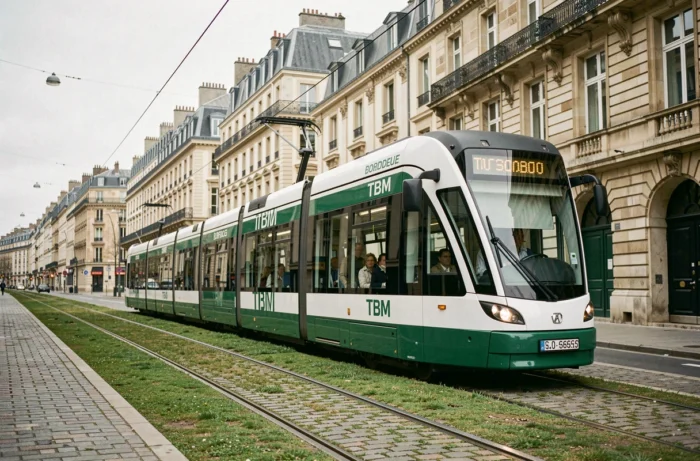
Finding your way on the Bordeaux tram network is not just about locating your station on a map. With six intersecting lines, multiple connections, and varying frequencies depending on the time of day, understanding the logic of the network changes how you move around. Here’s how to make the most of the TBM network to save time in your daily commute.
Peripheral-to-peripheral routes: the real innovation of the TBM network
You may have noticed that traveling between two suburban municipalities often requires passing through the city center? This is the classic flaw of star-shaped networks. The E and F tram lines in Bordeaux partially correct this issue.
The E line connects the right bank to employment areas without passing through historical hubs like Quinconces or the Saint-Jean station. The F line serves the northern part of the metropolis and creates direct connections between lines A, B, and C. In practical terms, a user traveling from a park-and-ride facility in the north to the right bank previously had to make two connections in the city center. With the new network layout, only one is needed.
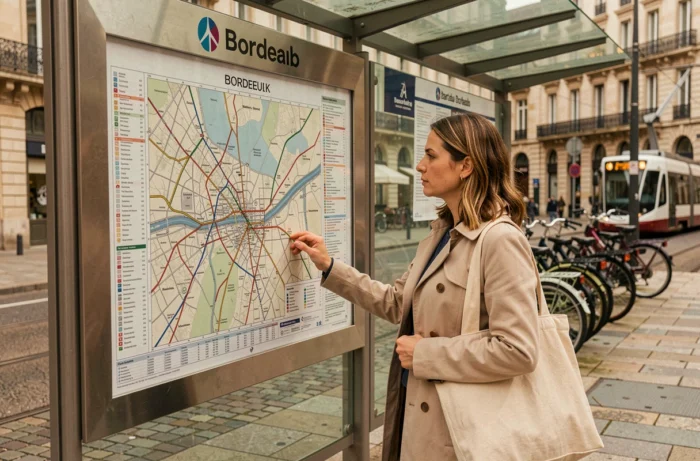
This crosswise logic reduces the total travel time and eases congestion at central stations during peak hours. To take advantage of this, you should consult the Bordeaux tram map by identifying the crossing points between lines rather than just the termini.
Frequencies and last services: what changes after 10 PM
The TBM network generally operates from 5 AM to around midnight. However, this range hides a detail that traps many users: the intervals between trams increase significantly in the evening.
After 10 PM, some lines operate at intervals that can exceed fifteen minutes. For a late-night connection, this means that a twenty-minute journey during the day can easily exceed forty minutes if the connection between two lines is poorly timed.
Bordeaux does not have a permanent night tram
Contrary to what some apps might suggest, no tram line runs after midnight on weekdays. The last service varies by line and station. Therefore, it is advisable to check the schedule for the last tram at your connecting station, not just at your departure station.
In practice, for a late return, two reflexes are useful:
- Consult the dynamic TBM map that displays the next services in real-time, including evening disruptions.
- Prefer a route with a single connection rather than a theoretically shorter journey requiring two changes, as the risk of missing a connection increases with decreasing frequency.
- Identify stations close to evening bus lines that can take over after the last tram.
Reading the tram map differently: key stations and connection hubs
Most schematic maps display lines by color, along with a list of stations. This is clear, but it doesn’t provide information on the best way to combine lines.
Instead of memorizing the complete route of each line, identify the strategic connection hubs of the network. These are the stations where at least two lines intersect and where the transfer time between platforms remains low.
Quinconces is not always the best choice
Out of habit, many users transit through Quinconces, the largest junction in the network. However, this station is also the busiest, which lengthens boarding and alighting times during peak hours. The E and F lines now offer alternative crossing points outside the center.
For a daily commute, testing two different routes over a week allows you to compare actual travel times. The shortest route in distance is not always the fastest in time, especially when the frequency of the connecting line is lower.
Combining tram, bike, and park-and-ride facilities in the Bordeaux metropolis
The tram does not cover the entirety of Bordeaux Metropolis. Some neighborhoods remain several minutes on foot from the nearest station. Two complements to the tram are worth integrating into your travel planning.
- Park-and-ride facilities located at termini or on the outskirts allow you to park your vehicle for free with a valid TBM transport ticket. They are particularly useful for users coming from municipalities not served by the tram.
- The bike-sharing network complements the tram for the last mile. Several bike stations are located in direct proximity to the busiest tram stops.
- The TBM Mobilités app brings together tram, bus, and bike options on a single interface, allowing you to compare options in real-time.
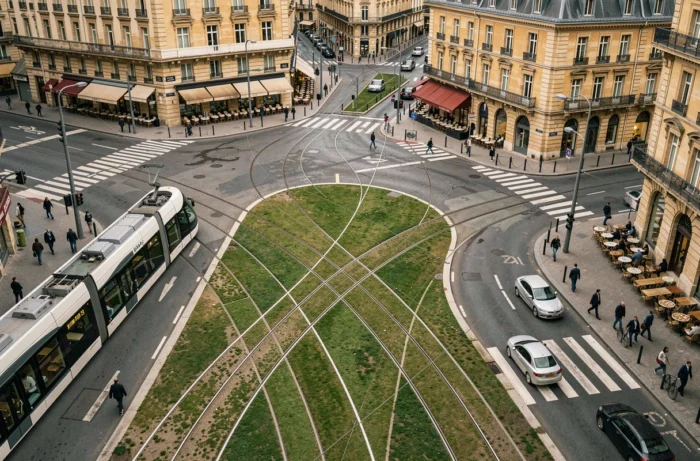
The TBM network in Bordeaux has become more complex with six tram lines. This complexity is an advantage when you know how to read it. Identifying cross connections and adjusting your routes to real-time schedules, especially in the evening, saves much more time than simply knowing the name of each station.