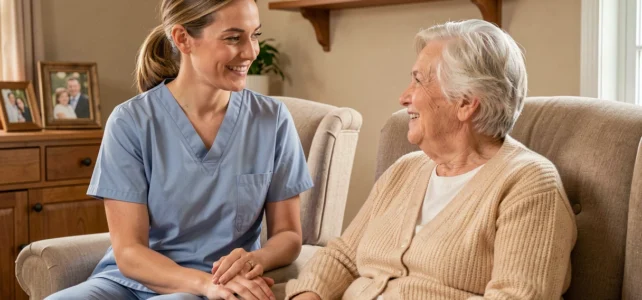
The shift to the home autonomy service model (SAD) redefines the value chain for supporting elderly individuals. This new framework, stemming from the reform initiated by the law of April 8, 2024, merges the former SAAD, SSIAD, and SPASAD into a single point of contact capable of covering daily assistance and care. Administrative deadlines extend until the end of 2026, and structures that do not complete their transition risk losing their authorization.
SAD and SPDA: two reforms restructuring the service offer for seniors
The home autonomy service does not merely rename the old structures. It imposes a pathway logic where a single operator coordinates personal assistance and nursing or physiotherapy care. For beneficiaries, this means a unified assistance plan, an identified contact person, and simplified billing.
In parallel, the Departmental Public Service for Autonomy (SPDA) is gradually being deployed across the territory. Created by the same law of April 8, 2024, it does not constitute an additional structure. It brings together existing stakeholders (departments, CPAM, pension funds, MDPH) to streamline orientation and assessment of needs. We observe that this coordination remains uneven across departments, with some having already structured an integrated service desk while others are still in the contracting phase.
The decree of July 7, 2024, also expands the scope of intervention: actions can now be carried out “at home or from home”. Shopping, travel to medical appointments, and participation in social activities are included in the notified assistance plan. This is a change in doctrine, not just a simple regulatory adjustment.
Several platforms already centralize these services for seniors on Your Health Assistant by providing a consolidated view of available services, which facilitates comparison between authorized SAD operators.

Criteria for selecting a home assistance provider for seniors
Not all SADs are equal. The reform imposes a common foundation, but the quality of service varies significantly based on internal governance, staffing ratios, and ongoing training policies.
We recommend evaluating a provider based on these operational criteria:
- The certification or departmental authorization for social assistance, which conditions coverage by the APA and guarantees regular oversight by the departmental council.
- The ratio of coordinators to field workers: one coordinator for more than forty home helpers mechanically reduces the individualized follow-up of assistance plans.
- The ability to ensure service continuity on weekends and public holidays, a recurring weak point for structures operating in a mandate mode where the employer remains the elderly person themselves.
- The effective integration of the care component (SSIAD) into daily operations, and not just on the paper of the SAD authorization.
The provider mode remains the most secure for families: the SAD is the employer, manages replacements, and assumes legal responsibility. The mandate mode or direct hiring is suitable for family caregivers capable of managing recruitment and administrative tasks themselves.
Funding and APA: often underutilized levers
The personalized autonomy allowance (APA) finances the majority of home assistance plans, but its amount depends on the GIR classification and the beneficiary’s resources. The out-of-pocket cost can vary from zero to several hundred euros per month for a GIR 4.
The tax credit for employing a home worker covers half of the incurred expenses, within the limits of the current tax ceiling. This mechanism applies to both provider mode and direct employment.
Complementary pension funds offer their own assistance, often unknown. Agirc-Arrco, for example, finances housekeeping hours for retirees classified as GIR 5 or GIR 6, thus not eligible for the APA. These extra-legal aids fill a blind spot in the public system.
The combination of these funding sources requires administrative engineering that few families can manage alone. Local information points linked to the SPDA are supposed to fulfill this orientation role, but their skill development remains gradual.
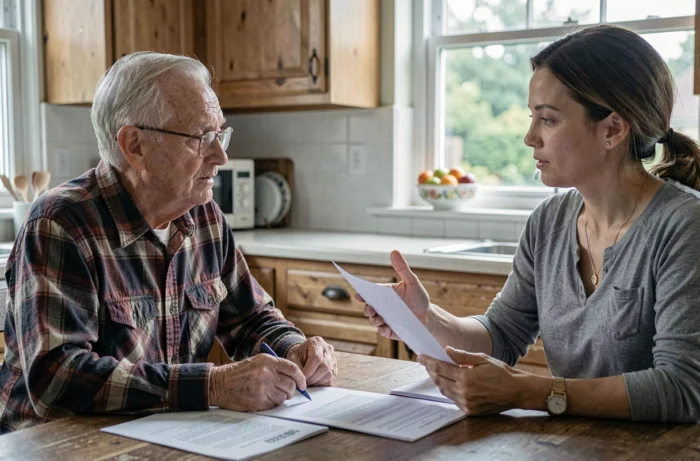
Home care or alternative accommodation: deciding based on the GIR
Staying at home is not always the appropriate response. For GIR 1 and GIR 2 profiles with severe cognitive impairments, the cumulative cost of a SAD worker intervening several hours a day, night care, and housing adaptations often exceeds that of a nursing home or a supervised senior co-housing arrangement.
Senior co-housing, supported by social and solidarity economy structures, constitutes an intermediate alternative. They offer a shared living environment with the presence of a coordinator while preserving a degree of autonomy that traditional institutions do not always allow.
Approved family hosting remains the least known and least saturated option. A family host accommodates one to three elderly individuals in their home, in exchange for a remuneration regulated by the department. The control is annual, and the cost for the hosted person is generally lower than that of a nursing home.
The choice between these options relies on three variables: the level of dependency measured by the AGGIR grid, the net budget after mobilizing all aids, and the presence or absence of a family caregiver capable of ensuring daily coordination. A well-constructed assistance plan integrates these three dimensions from the initial assessment.
The ongoing structuring of the SPDA should ultimately allow for quicker routing to the best-calibrated solution. In the meantime, the responsibility for this decision-making still largely rests on families and the field professionals who support them.