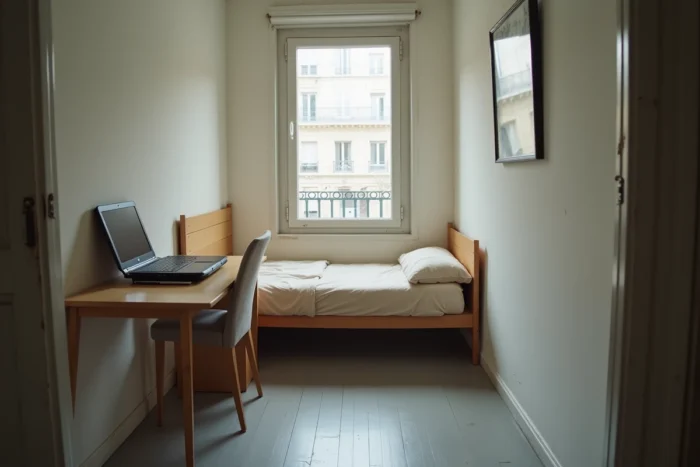
The 9 m² threshold for a bedroom comes up in almost all discussions between landlords, tenants, and real estate agents. This reference comes from the decree of January 30, 2002, which defines the criteria for the decency of a rental property. The text requires that a main room has a living area of at least 9 m² with a ceiling height of at least 2.20 meters, or a living volume of at least 20 m³.
As 2026 approaches, several regulatory changes are altering the scope of this threshold and its consequences for landlords.
Departmental health regulations and rooms under 9 m²: a local constraint often overlooked
Most online content focuses on the 2002 decree, which concerns the decency of rented housing. Another text goes under the radar: the departmental health regulation (DHR). In Paris, the DHR sets a minimum area of 9 m² per person for any room intended for sleeping. This rule does not only target rentals; it also applies to personal use.
The distinction is significant. The 2002 decree refers to the main room of the dwelling, not specifically to bedrooms. The DHR, on the other hand, directly targets rooms used for sleeping. A Parisian landlord who converts a 7 m² room in an apartment where the living room exceeds 9 m² may comply with the decency decree while being in violation of the DHR.
Each department has its own health regulation. The thresholds and wording vary. Before converting or renting a small room, checking the DHR of the relevant department remains the first precaution to take. To better understand what the law provides for rooms in 2026, one must cross-reference these two levels of regulation.
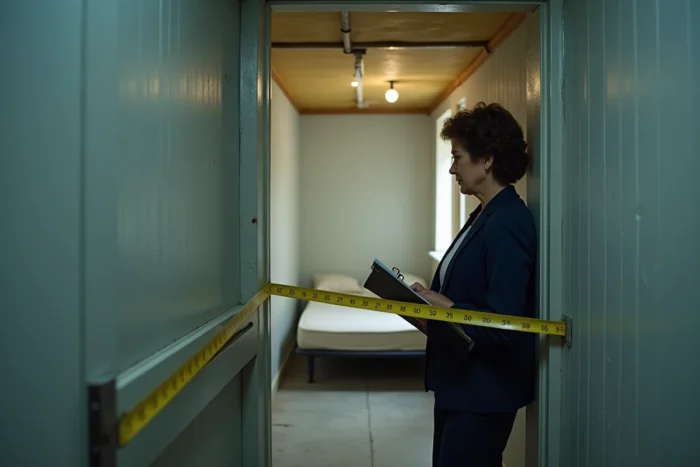
Loss of housing assistance for rooms below the 9 m² threshold: the direct financial effect
Articles discussing the minimum area often overlook a crucial angle: a room of less than 9 m² occupied alone does not allow for housing assistance rights. For students and young professionals, this consequence radically changes the financial equation of housing.
A landlord renting out an 8 m² room in a student residence faces a paradox. The housing may comply with decency criteria if the living volume reaches 20 m³ (thanks to a ceiling height exceeding 2.50 m, for example). However, the tenant will not be able to receive housing assistance.
In the market for small student accommodations, the loss of housing assistance reduces the tenant’s solvency and, by extension, the actual rental value of the property. Landlords targeting this segment have an interest in accurately measuring the living area before any rental.
What this changes for the landlord
The risk is not limited to a property being vacant longer. A tenant who discovers after signing that they cannot benefit from housing assistance has recourse. They can approach the departmental conciliation commission or the court to request a compliance of the housing or a rent reduction.
The landlord also exposes themselves to sanctions if the housing is deemed non-decent by a judge. A formal notice to carry out works, accompanied by a withholding of rents, is among the measures that the court can order.
Decency, area, and living volume: the criteria to check before renting in 2026
The 2002 decree presents an alternative: 9 m² of living area or 20 m³ of living volume. This dual condition is often misunderstood. Many landlords only consider the area threshold and ignore the volume criterion. The two are not cumulative; either one is sufficient.
In practice, the volume of 20 m³ allows a dwelling with a main room slightly less than 9 m² to be classified as decent, provided that the ceiling height compensates. An attic room of 8.5 m² with an average height of 2.40 m reaches a volume of 20.4 m³ and therefore meets the decency threshold.
- The living area is calculated according to the Boutin law: it excludes parts with a ceiling height of less than 1.80 m, unconverted attics, cellars, and garages.
- The living volume takes into account the entire volume of the room, but only for parts where the height exceeds 1.80 m.
- Integrated closets, door and window frames, and stair steps are not counted in the living area.
This distinction has concrete consequences for older housing, converted attics, and small rooms under the roofs. Measuring the living volume can save the compliance of a dwelling that the area alone would have disqualified.
The specific case of ceiling height
The decree sets a minimum ceiling height of 2.20 m. In Haussmannian buildings or old converted buildings, some rooms have recesses, beams, or slopes that temporarily reduce the height. Only areas exceeding 1.80 m are taken into account in the calculation of the Boutin living area.
A landlord who has a surface diagnosis performed must ensure that the professional applies this method. Measurement errors are common and can reclassify a decent dwelling as non-compliant, or vice versa.

Strengthened obligations in 2026: what evolves concretely for landlords
In the Brussels region, new minimum quality standards for rental housing came into effect on January 1, 2026. While the French framework has not undergone a comparable overhaul at the same date, the strengthening of compliance and decency checks continues.
The CAF is intensifying surface checks during housing assistance applications. Diagnosticians are increasingly being called upon to produce usable living area certificates in case of disputes. The tenant has enhanced tools to contest the decency of their housing.
- The tenant can ask the landlord to justify the living area of the property before or after signing the lease.
- In case of doubt, they can approach the CAF, which can suspend the payment of assistance and request a verification.
- The judge can order the execution of works to bring the property into compliance and reduce the rent during the duration of the works.
For a landlord, the current period requires checking each property against the 2002 decree, the local DHR, and the eligibility conditions for housing assistance. A professional measurement is inexpensive compared to the financial risks of a dispute.
Having this diagnosis done before renting remains the safest approach to avoid unpleasant surprises.