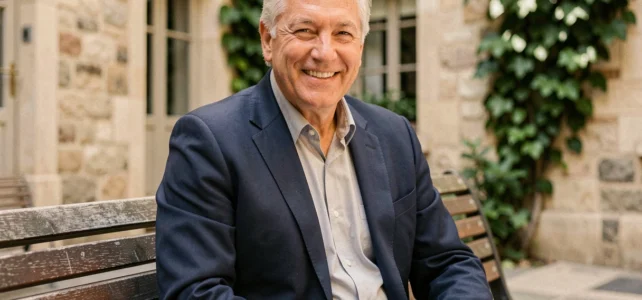
Marc Toesca presented the Top 50 on Canal+ for nearly a decade, becoming one of the most recognizable faces of French television in the 1980s and 1990s. His media career is well-documented. His private life, however, remains almost uncharted territory for the gossip press as well as for online archives.
Verifiable sources about his partner and family can be counted on one hand. This article reviews what is confirmed, what is speculative, and what this discretion says about the relationship between celebrity and intimacy in France.
Marc Toesca and Sabine: what the photo captions reveal
The first name of Marc Toesca’s wife does not appear in any interview published by the host himself. It emerges indirectly: through the captions of agency photos (BestImage, PRM) taken at official events.
The best-documented context is the gala Fight Aids Monaco on July 24, 2021. In the pictures released by these agencies, the woman accompanying Toesca is identified by the first name Sabine. This detail, however minor, constitutes the only verifiable information about her identity.
Looking into Marc Toesca’s family life, we find that the few images of the couple come exclusively from charitable events in Monaco, in a very controlled setting. Sabine has no media presence of her own: no interviews, no portraits in the press, no identified public account on social media.
No serious media outlet documents the date of the marriage, the type of ceremony, or Sabine’s profession. Gossip articles generally just mention “his wife” without further details.

Marc Toesca’s discretion: strategy or temperament
The boundary between public life and private life varies in thickness depending on the personalities. For Marc Toesca, this boundary resembles a load-bearing wall.
Several elements point to a deliberate approach rather than mere media disinterest:
- The couple’s public appearances are limited to charitable galas, contexts where presence is regulated and photos are managed by professional agencies, not by paparazzi
- Toesca has never given an interview focused on his marital or family life, even in the “intimate portrait” formats regularly offered by magazines like Gala or Paris Match
- No information about any potential children of the couple circulates in reliable sources, indicating an effective lock on the personal sphere
This stance contrasts with that of many hosts of his generation, who have accepted (even sought) media coverage of their private lives. Toesca seems to have drawn a line very early on and has stuck to it.
The weight of paternal legacy
Marc Toesca is the son of Claude François, who kept him out of the public eye during the early years of his life. According to testimonies relayed by the press, young Marc lived at the Moulin de Dannemois without appearing publicly for several years, a decision made by Claude François to protect both his own public image and that of the child.
This childhood experience, marked by secrecy and the separation between the father’s media sphere and family reality, may have lasting effects on Toesca’s relationship with public exposure. The available data do not allow for a definitive conclusion about this causal link, but the consistency between the hidden childhood and adult discretion is striking.
Marc Toesca after the Top 50: a life away from Paris
After the end of the Top 50, Toesca did not transition to another high-visibility program. He gradually stepped away from the Parisian media spotlight.
Interviews given to La Provence show a man focused on music and memories, able to nostalgically discuss “summer hits” without ever slipping into personal confessions. The Monaco living environment appears to be a coherent choice: Monaco offers an environment where discretion is culturally respected and legally protected.
This geographical and media withdrawal partly explains why information about his family life is so rare. A host based in Paris, participating in studio shows or podcasts, would necessarily let more personal elements filter through.

Private life of personalities in France: the limits of public curiosity
The Toesca case illustrates a broader phenomenon. In France, the right to one’s image and the protection of private life provide a solid legal framework for personalities wishing to maintain a strict separation. Articles 9 of the Civil Code and associated case law allow for effective action against unauthorized publications.
The gossip sites that mention “Marc Toesca’s wife” without providing details are not exhibiting journalistic negligence. They reflect a reality: there is simply nothing published with the subject’s consent. The captions of agency photos remain the only usable material.
This situation creates a paradox. The absence of information fuels curiosity, which generates online searches that lead to articles poor in factual content. The cycle repeats itself without the raw material, Toesca’s own words, ever coming to feed it.
Marc Toesca has built, whether intentionally or not, one of the most protected private lives in the French audiovisual landscape. The first name Sabine, a few gala photos in Monaco, and decades of silence on everything else: this is what verifiable sources allow us to affirm. The rest belongs to the host, and he does not seem in a hurry to share it.