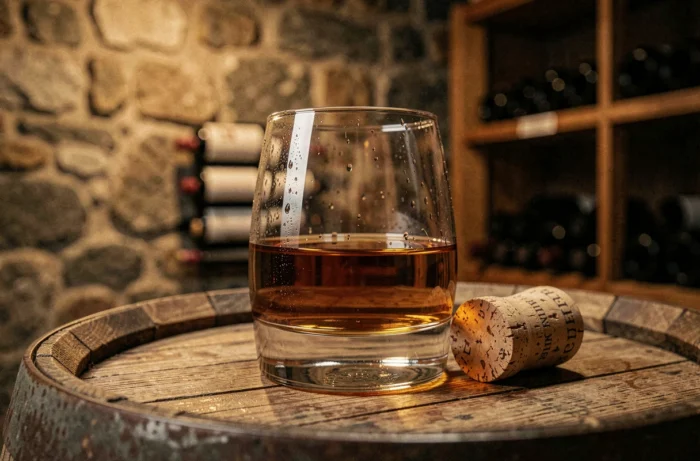
How does a French single malt sold in supermarkets compare with Scottish or Japanese whiskies backed by decades of standardized production rules? Fondaudège whisky, produced by Whiskies du Monde and bottled at 40% ABV, touts maturation in French oak casks and double distillation without chill filtration. Are these technical specifications enough to bring it up to the international standards of the category?
French oak versus American oak: how the wood changes what’s in the glass
Most whisky comparisons stop at tasting notes. The choice of cask, however, has a major influence on the final aromatic profile. Fondaudège uses French oak (Quercus robur or Quercus petraea), the same wood used to age Bordeaux wines and Cognac.
This type of oak releases more pronounced tannins and distinct vanilla compounds compared with American oak (Quercus alba), the standard in the Scotch and bourbon industries. In practice, this means a more prominent oaky character from the early years of maturation, whereas American oak casks tend to bring out caramel and coconut notes.
A detailed article offering a review of Fondaudège whisky confirms that the absence of chill filtration preserves more fatty compounds in the spirit, enhancing its roundness on the palate. This process, common among independent Scottish bottlers, remains rare in the supermarket segment.
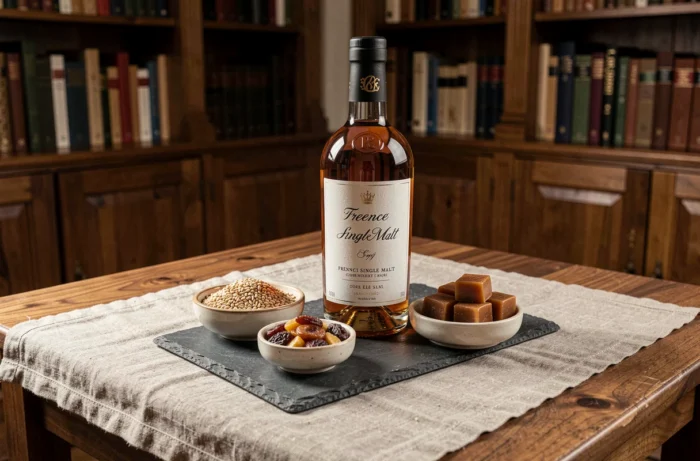
Fondaudège versus Scottish and Japanese single malts: comparison table
Comparing whiskies from different countries means distinguishing between category (malt, grain, blend) and aromatic style. Fondaudège is presented as a French pure malt, making it closer to a Scottish single malt than to a bourbon or a blend.
| Criterion | Fondaudège Héritage | Entry-level Scottish single malt | Entry-level Japanese single malt |
|---|---|---|---|
| Predominant cask type | New French oak | American oak (ex-bourbon) | Japanese oak (mizunara) or American oak |
| Distillation | Double distillation | Double distillation (pot still) | Variable (double or triple) |
| Chill filtration | No | Often yes at entry level | Variable |
| Main distribution channel | Supermarkets | Supermarkets and specialist wine and spirits shops | Specialist wine and spirits shops and e-commerce |
| Aromatic profile | Ripe pear, vanilla, sweet almond, short finish | Citrus, honey, gentle spices, medium finish | Floral, delicate oak, long finish |
The table highlights one key difference: Fondaudège’s short finish remains its recurring weak point in tasting feedback. Entry-level Scottish single malts generally have greater aromatic persistence than Fondaudège, even at the same ABV.
What the retail price really reflects
Fondaudège Héritage is sold in supermarkets at a price that puts it in direct competition with blended Scotch and slightly below the most common Scottish single malts. This pricing reflects a deliberate choice: making single malt accessible in the spirits aisle of supermarkets, a segment where French whisky was virtually absent ten years ago.
Entry-level Japanese single malts, by contrast, command significantly higher prices because of limited stocks and import costs. Value for money therefore cannot be reduced to a tasting score: availability and ease of purchase also factor in.
“Whisky de France” GI proposal: a framework that is still missing
One aspect rarely covered in comparisons is the regulatory framework. While Scotch whisky benefits from strict regulations (Scotch Whisky Regulations), French whisky does not yet have a protected geographical indication. A “Whisky de France” GI proposal is under review by INAO, but has not yet been approved at European level.
The proposal notably includes:
- A minimum proportion of French-grown cereals in the mash
- Distinctions between several national categories (malt, grain, blended) to avoid confusion
- Rules governing cask-finish claims, making ageing statements easier to verify
For Fondaudège, whose marketing highlights finishing in casks that previously held eaux-de-vie, adoption of this GI would require precise documentation of the duration and nature of each ageing stage. The current lack of such a framework makes comparisons with Scotch structurally uneven: on one side, a century-old set of production rules; on the other, an industry still taking shape.
Detailed aromatic profile: who will enjoy Fondaudège?
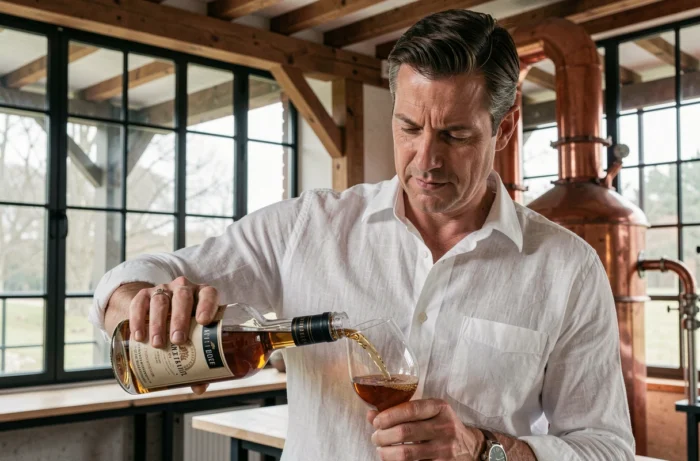
On the nose, Fondaudège offers aromas of ripe pear, vanilla and sweet almond. On the palate, it is rounded and slightly honeyed, with a cereal note in the background. This places it in a fruity, gentle style, far removed from peated single malts or heavily oaked expressions.
This style suits consumers who:
- Are new to single malt and want a gentle introduction without harsh tannins
- Are looking for a light sipping whisky to enjoy as an aperitif or with dessert
- Prefer the convenience of finding it in a supermarket to searching specialist wine and spirits shops
By contrast, drinkers who enjoy long finishes, tertiary complexity or peated profiles may find Fondaudège too linear. Its strength is also its limitation: its approachable taste comes at the expense of depth.
Fondaudège in a cocktail or neat: two distinct uses
Fondaudège’s roundness and fruity notes make it a practical base for simple cocktails (highball, whisky sour). Its short finish, seen as a drawback when sipped neat, becomes an advantage in mixology: it leaves room for the other ingredients without an overpowering lingering taste.
French whisky now occupies a genuine market segment, with a distinctive aromatic profile and a distribution channel that makes it accessible to a broad audience. The missing piece is still the regulatory framework: until the “Whisky de France” GI is adopted, comparing Fondaudège with Scotch means measuring two products by different rules.