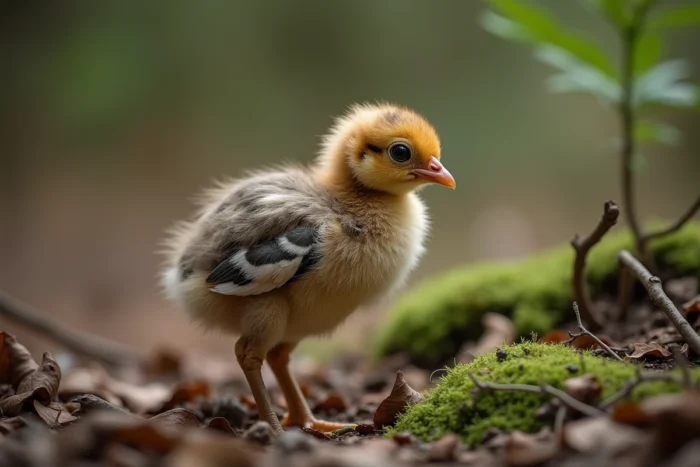
Recognizing a baby pheasant among other chicks of gallinaceous birds requires knowing what to observe: down color, leg size, beak shape. The development of the pheasant chick follows a precise timeline, from hatching to the appearance of adult plumage, with stages where feeding, thermoregulation, and predation play very different roles depending on the chick’s age.
Pheasant chick down compared to chicks of other gallinaceous birds
The most common confusion involves chicks of partridges, quails, and pheasants, which share a striped brown-beige down. A table helps distinguish these species from the first days of life.
| Criterion | Common pheasant chick | Grey partridge chick | Quail chick |
|---|---|---|---|
| Size at hatching | Larger, long legs | Medium size, stocky | Very small, fits in the palm |
| Down color | Brown-yellow with distinct dark stripes on the back | Brown-red, less contrasting stripes | Pale yellow to light brown, fine stripes |
| Beak shape | Thin and slightly elongated | Short and rounded | Very short and pointed |
| Ground behavior | Runs quickly, freezes flat | Groups tightly | Disperses and flattens individually |
The pheasant chick is especially distinguished by its proportionally long legs compared to its body. This detail is noticeable from hatching, while partridge and quail chicks have stockier legs.
The dorsal stripes of the baby pheasant are bold, almost black on a warm background. This camouflage pattern allows it to blend into low vegetation, but it gradually disappears as the first feathers break through the down. To identify a baby pheasant with Boule de Poil, these visual criteria remain the most reliable before the age of two weeks.
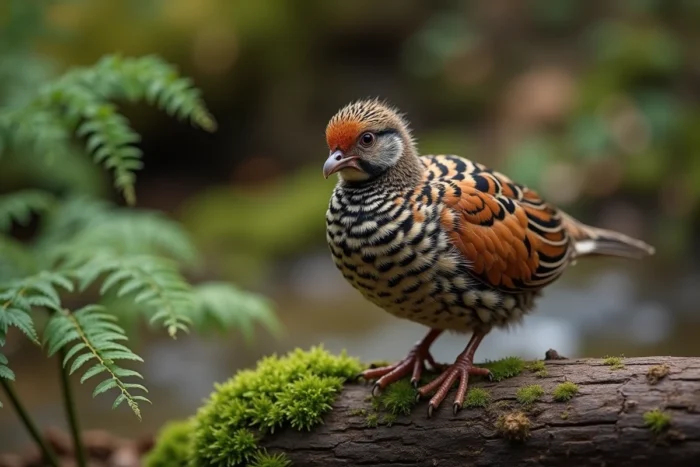
Feeding of the pheasant chick according to its age
The diet of the pheasant chick changes radically between hatching and the end of the first month. Young chicks feed on insects until they are three weeks old, before gradually shifting to a plant-based diet of seeds and small plants.
This dependence on invertebrates during the first weeks of life explains why the survival of chicks is directly linked to the entomological richness of the environment. A meadow mowed too early or a field treated with insecticides deprives pheasant chicks of their main food source when they need it most.
Insects, proteins, and feather growth
The animal proteins provided by beetles, ants, and larvae are the fuel for feather growth. Without this protein intake, the development of flight feathers shows a visible delay.
In farming, this is compensated with a starter feed rich in protein. In the wild, the hen guides her chicks to areas where the density of insects is highest, often at the edge of hedges or in uncut grassy strips.
After three weeks, the diet diversifies. The pheasant chick begins to peck at seeds, berries, and tender leaves. The adult then primarily feeds on seeds and small plants, with occasional supplementation of invertebrates.
Thermoregulation and vulnerability of the pheasant chick to extreme temperatures
Pheasant chicks are precocial birds: they leave the nest within hours of hatching. This behavioral precocity does not mean they are thermally autonomous.
The thermoregulation of the pheasant chick is immature during the first two weeks. The chick relies on the hen for warmth. In farming, an artificial heat source (infrared lamp, heating plate) replaces this maternal role.
Thermal stress in farming during heatwaves
Several agricultural organizations report a higher mortality rate among young poultry during recent heatwaves, with a particularly marked impact on individuals whose thermoregulation is still ineffective. Pheasant chicks raised at too high a density in poorly ventilated buildings are the first to be affected.
The recommended adaptations to limit these losses include:
- Reducing the density of birds per square meter, especially in the first two weeks of life
- Installing enhanced ventilation or misting in breeding facilities
- Shifting feeding times to cooler parts of the day
- Monitoring water consumption, which increases significantly during hot periods
In the wild, the hen compensates by seeking shade from dense vegetation. Broods located in low crops without tree cover experience higher mortality during heat peaks.
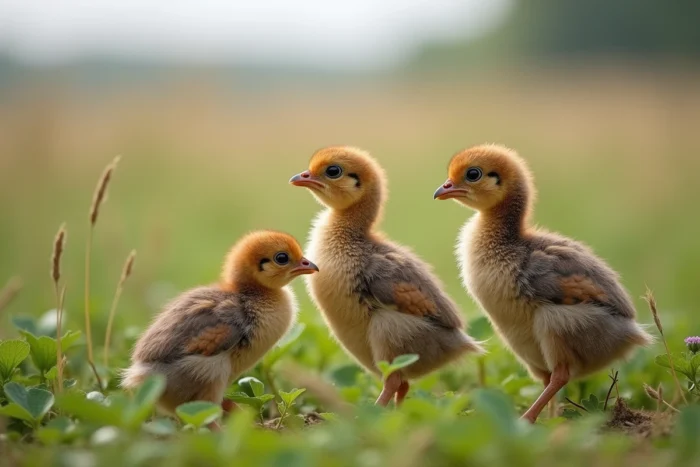
Feathering of the young pheasant: distinguishing male and female before maturity
Sexual dimorphism in the common pheasant is spectacular in adults: the male displays copper, green, and red colors, while the female (hen) remains in brown and beige tones. In chicks, this difference is invisible.
Sexual dimorphism only appears after several weeks, when the first contour feathers replace the juvenile down. Young males begin to show warmer reflections on the chest and neck, while young females retain a uniform cryptic plumage.
Determining age by plumage
A document from ONCFS describes a method for determining the age of pheasants based on plumage observation, usable up to about five months. The criteria focus on the length and shape of the remiges, the presence of residual juvenile feathers, and the coloration of the tail.
The tail of the male, the most visible characteristic in adults, remains short in the young for several months. Tail length is the most reliable marker for estimating the age of a young pheasant between two and five months.
- Complete down: from hatching to about ten days
- First visible flight feathers: between the second and third week
- Beginning of sexual coloration: variable among individuals, generally after the first month
- Recognizable sub-adult plumage: around three to four months
The common pheasant is among the gallinaceous birds with the most documented feather development, particularly because hunting federations and game farms need to estimate the age of birds before release. This determination of age by plumage remains the reference method in the field, without invasive handling.
The natural mortality of pheasant chicks concentrates in the first three weeks, when the down does not protect against cold or rain, and when the diet relies on sometimes rare insects. A brood that passes this critical stage has a good chance of producing viable birds by autumn.