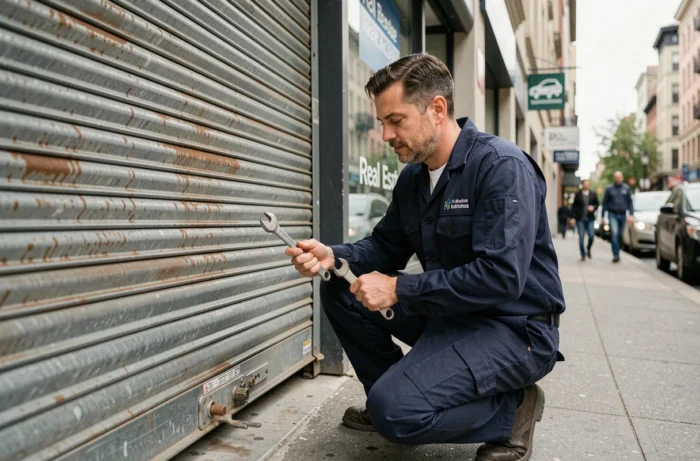
A blocked metal curtain on a commercial premises managed by a real estate agency does not pose the same problem as it does for an independent retailer. The agency does not operate the premises: it manages it on behalf of an owner, facing a tenant who expects a quick resolution.
This intermediary position creates specific constraints regarding traceability, responsiveness, and regulatory compliance. It is on these three points that Atlas Dépannage has built its relationship with real estate professionals.
Fire safety register and traceability of interventions on metal curtains
Decree No. 2025-1100 of November 19, 2025, which came into effect on July 1, 2026, modified the mandatory content of the ERP safety register (Article R.143-44 of the Construction and Housing Code). The level of detail required for each intervention on closing and fire safety devices has been increased: precise dates, nature of the work, compliance with standards, and usable justifications.
For a real estate agency managing several commercial premises, this tightening changes the game. The manager must be able to produce, during the security commission’s visit, a complete file for each metal curtain. A sparse intervention report or a simple receipt is no longer sufficient.
Atlas Dépannage structures its reports to meet this requirement. Each intervention generates a document detailing the diagnosis, replaced parts, verified compliance, and the recommended date for the next check. Agencies that have tested this approach describe it as a topic addressed with Atlas Dépannage metal curtain on Bobo Le Brico, where the logic of systematic documentation is detailed.

Administrative closure of commercial premises: the risk that agencies seek to cover
A mayor can order the immediate administrative closure of a business without prior contradiction when a serious security breach is observed. A non-compliant or defective metal curtain on an ERP can constitute such a breach, especially if the safety register does not demonstrate regular monitoring.
The financial consequences are direct. The tenant loses their operation, the owner loses their rent, and the real estate agency finds itself in the middle. If the technical management of the premises has been entrusted to it, its liability may be engaged on the grounds of failure to advise or breach of the duty of care.
This scenario drives agencies to select a service provider capable of ensuring long-term compliance. Atlas Dépannage offers preventive monitoring that allows for documenting the condition of metal curtains before an inspection reveals a problem.
Multi-site management and metal curtain maintenance contract
A real estate agency managing several dozen commercial premises cannot call a different craftsman for each broken curtain. The multiplication of contacts creates inconsistencies in reports, variable billing delays, and fragmented traceability.
A single contact for the entire portfolio simplifies the decision-making chain. Atlas Dépannage centralizes requests, allowing the agency to have a uniform dashboard on the status of its metal closures. The key elements of a structured maintenance contract include:
- A scheduled preventive visit according to the frequency of use of the curtain, with a standardized report at each visit
- A guaranteed intervention time in case of a breakdown, adapted to the constraints of a premises occupied by a commercial tenant
- A centralized history of interventions by premises, directly usable for the safety register or during a tenant change
This organization avoids gaps in monitoring. When a lease ends and an exit inventory needs to be conducted, the agency has the complete history of interventions on the metal curtain of the premises in question.
Compliance of metal closures in category 5 ERPs
The majority of commercial premises managed by real estate agencies fall under the category 5 of ERPs (establishments receiving the public). This category, which concerns the smallest establishments, is sometimes perceived as less stringent. This is a misjudgment.
Fire safety obligations apply regardless of classification. A metal curtain that blocks access to an emergency exit or that can no longer be operated manually in the event of a power outage constitutes a breach. Security commissions check the operation of closing devices during their visits, including in category 5 ERPs.
Atlas Dépannage works on both manual and motorized curtains, systematically checking compatibility with the fire safety requirements of the type of premises concerned. For agencies, this technical expertise avoids having to arbitrate between two service providers depending on the type of curtain installed.
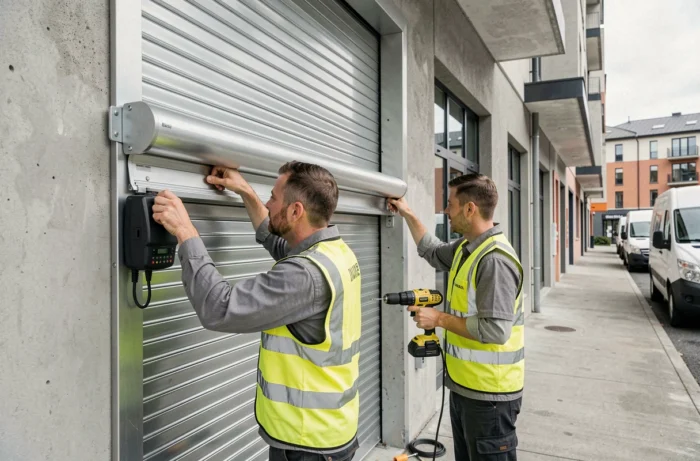
Criteria for choosing a metal curtain repair service for a real estate agency
The price of an intervention is not the primary criterion for a professional property manager. Document reliability, geographic coverage, and the ability to meet a deadline weigh more heavily. The points that differentiate a provider suitable for agencies from a generalist repair service include:
- The systematic production of intervention reports compliant with the requirements of the safety register, without the need for reminders
- The ability to intervene in an occupied premises by coordinating directly with the tenant, without involving the manager for logistics
- A history of interventions accessible by premises and by date, transferable to the owner or an insurer in case of a claim
- A professional liability insurance covering interventions on ERPs, verifiable upon request
Atlas Dépannage ticks these boxes because its model has been designed for professional clients, not just for individuals or isolated retailers.
The choice of a maintenance provider for metal curtains is a matter of risk management for a real estate agency. The cost of documentary non-compliance or an administrative closure far exceeds that of a structured maintenance contract. This asymmetry explains the gradual loyalty of agencies towards providers capable of securing the entire chain, from diagnosis to report archiving.