The French regulatory framework surrounding early childhood awakening has recently evolved, and these changes directly affect the practices of both professionals and parents. Supporting a child’s development is not just about providing age-appropriate toys. It involves understanding the neurological mechanisms at play, respecting individual rhythms, and considering the normative constraints that now shape the environment of the very young.
Screen Regulation and Awakening: What is Changing in France
Since July 2, 2025, screen exposure is prohibited in all early childhood care facilities in France, including nurseries, micro-nurseries, and with registered childminders. This ban also covers having the television on as background noise, a point often underestimated by families.
The health booklet given at birth has included since January 2025 the explicit mention “no screens before 3 years, including background noise.” This inscription places screen prevention on the same level as vaccination guidelines or growth monitoring.
We observe that these measures have a direct impact on the design of awakening spaces. Early childhood professionals must rethink the arrangement of living spaces so that stimuli come exclusively from human interactions and physical supports. This is a paradigm shift for structures that still used so-called “educational” video content.
For parents seeking reliable resources on developmental stages and age-appropriate activities, it is possible to learn more on Maman Louzou, which addresses these topics in detail.
Toy Rotation and Sensory Overload: The Right Balance
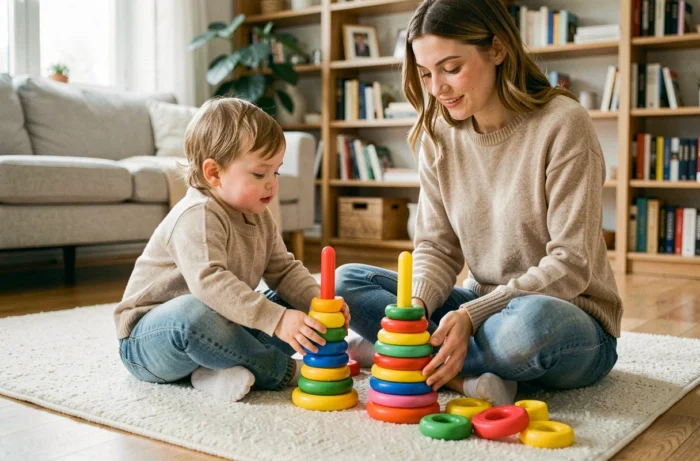
Presenting three to four objects at a time is enough to maintain curiosity without triggering sensory overload. We recommend a weekly rotation system rather than permanent access to all available toys.
Sensory overload is a documented phenomenon in young children. Too many simultaneous stimuli (bright colors, multiple sounds, varied textures at the same time) fragment attention and reduce the duration of exploration for each object. The child flits from one thing to another instead of delving deeper.
Selection Criteria for an Effective Awakening Object
- One dominant sensory channel per object: a sound rattle, a textured fabric, a contrasting book. Avoid multifunctional toys that engage sight, touch, and hearing simultaneously before 12 months.
- Materials compliant with EN 71 standards (toy safety). FSC-certified wood remains the reference material for its durability and sensory neutrality, as opposed to plastics that sometimes emit off-putting odors.
- A size suitable for grasping: the object should fit in the child’s palm without needing both hands before the age of bilateral coordination (around 6-8 months).
- The absence of electronic mechanisms for children under 18 months, consistent with the screen-free environment logic.
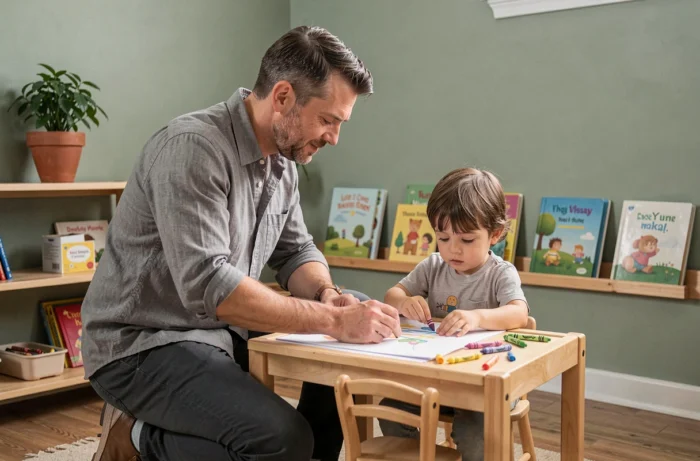
This rotation principle also applies to books. Three freely accessible albums, renewed weekly, generate more language interactions than an entire library left available.
Free Movement and Coordination: Let the Floor Do Its Work
Free movement remains the most documented approach to promote motor development. A hard floor covered with a thin mat is preferable to a thick mattress that absorbs support and distorts the proprioceptive feedback of the infant.
We observe a trend towards multiplying equipment (bouncers, walkers, positioning cushions) that keep the child in postures they have not yet acquired independently. This postural anticipation disrupts the natural sequence: rolling over, crawling, sitting, standing on all fours, standing upright.
Motor Stages Not to Be Short-Circuited
Each acquisition prepares the next. A child who has not crawled long enough sometimes develops less fluid cross-coordination. Crawling engages contralateral arm-leg coordination, the foundation for walking and, later, skills like writing.
The parent’s role is to secure the space and remain available without intervening physically. Placing an object slightly out of reach motivates movement, but forcing the child into a standing position by pulling them by the hands is counterproductive.

Language and Verbal Interactions: Quality Over Quantity
Talking to a child is not enough. It is the “turn-taking” that builds language, not the adult’s monologue. The effective pattern is simple: the adult speaks, pauses, waits for a babble or gesture from the child, then responds.
This “serve and return” mechanism (a neuroscientific term also referred to in French literature as “back-and-forth exchange”) strengthens the neural connections related to language much more than passive exposure to speech.
Common Mistakes in Language Stimulation
- Correcting the pronunciation of a child under 3 instead of naturally reformulating. If the child says “tato”: respond “yes, it’s a cake” without emphasizing the mistake.
- Asking closed questions (“do you want this?”) instead of open questions (“what do you see?”) as soon as the child starts pointing, around 10-12 months.
- Using deliberately simplified vocabulary. Naming objects by their real names (“dragonfly” instead of “flying bug”) enriches the lexical stock without slowing down comprehension.
The sound environment also matters. Constant background noise (music, radio, prolonged phone conversations) reduces the child’s ability to isolate language sounds and discriminate phonemes.
Supporting a child’s awakening relies on simple yet precise actions: a stripped-down space, carefully chosen objects, time on the floor, and structured verbal exchanges. The best stimulations are often those that require the least material and the most attentive presence.