
A natural garden is not just about stopping pesticides. It’s a set of concrete choices regarding soil, plants, water, and even light that, combined, create a space where biodiversity can settle sustainably. Here are the most effective levers to transform your garden into an environmentally friendly ecosystem without sacrificing its aesthetics.
Light pollution in the garden: a blind spot in ecological gardening
Have you ever noticed swarms of insects circling around a streetlight in the summer? This phenomenon occurs on a smaller scale in every garden equipped with lights, strings, or posts that stay lit all night. Nocturnal insects, especially moths, are disoriented by these light sources. Their mortality increases, and the entire local food chain is affected.
Bats, which are major consumers of mosquitoes, avoid overly lit areas. The paradoxical result is that the more you light up your garden, the more mosquitoes proliferate in the dark corners where their predators no longer hunt.
Several municipalities and the Swiss Federal Office for the Environment now recommend reducing or turning off garden lighting at night. Specifically, this means directing lights towards the ground (never towards the sky or hedges), favoring motion detectors over permanent lighting, and turning off all outdoor lights after a certain hour. An environmentally friendly garden also involves this simple action, which you can adopt to learn more about Gardening Naturally and deepen your practices.
Living soil: nourishing the earth rather than the plants
Most chemical fertilizers short-circuit a fundamental mechanism. They feed the plant directly but deplete soil life. However, it is the microorganisms, fungi, and earthworms that make nutrients assimilable in the long term.
Compost as a basis for natural fertilization
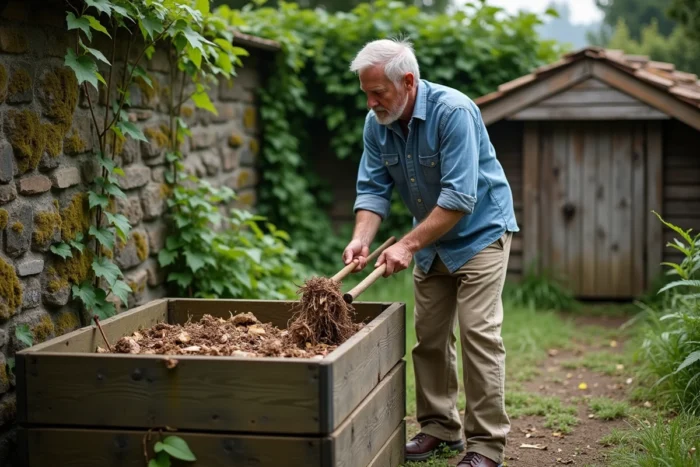
Well-managed domestic compost provides a rich and balanced amendment. Peels, dead leaves, coffee grounds, dried grass clippings: these materials decompose in a few months and nourish the soil deeply without the risk of pollution.
Spread the compost on the surface in a thin layer around the plants. Earthworms will incorporate it. This technique, called nutrient mulching, also protects the soil from drying out.
Keeping the soil covered year-round
A bare soil is an eroding soil, compacted by rain and losing its organic matter. Ground cover plants, a mulch of dead leaves, or even green manures sown in the fall (mustard, phacelia) keep the earth alive between two growing seasons.
- Organic mulch (straw, branch chippings, leaves): protects from drought, nourishes the soil as it decomposes, and limits the growth of weeds without herbicides.
- Green manures (clover, vetch, phacelia): their roots loosen the soil and fix atmospheric nitrogen, reducing the need for fertilization the following spring.
- Perennial ground covers (creeping ivy, bugle): once established, these plants require little maintenance and provide a permanent refuge for soil insects.
Native plants and the fight against invasive exotic species
Planting locally is not just a trend. Native plant species have co-evolved with the fauna of your region for thousands of years. A black elder or a bloodtwig dogwood nourishes many more birds and insects than an imported cherry laurel.
In contrast, some exotic plants pose a real problem. Japanese knotweed, butterfly bush, or black locust, for example, invade neighboring natural spaces and suffocate local flora. Official blacklists are updated by environmental authorities to help individuals identify these species. The Charter of Gardens in French-speaking Switzerland explicitly requests that no invasive exotics be planted and, if possible, that those already present be removed.
Before buying at a garden center, check if the species is on these lists. Favor local nurseries that offer varieties suited to your area’s climate and soil.
Ecological corridors between gardens: thinking beyond your fence
An isolated garden, even if perfectly managed, remains an island. Hedgehogs, toads, and pollinating insects need to move from one green space to another to feed and reproduce. This is the concept of ecological corridors.
Why does this concept change the game? Because continuity between neighboring gardens matters as much as what grows in each plot. Specifically, this translates into simple actions.
- Leave a hand-sized passage at the bottom of fences so hedgehogs can move from one garden to another.
- Avoid systematically weeding the bases of walls and sidewalks, which serve as micro-corridors for many insects.
- Favor mixed hedges of local species over solid fences, to provide food and shelter while allowing wildlife to circulate.
- Coordinate your practices with your neighbors: a band of wildflowers crossing several properties multiplies its effect on biodiversity.
Field feedback from naturalist networks confirms that these plant continuities between private plots are a major lever for local wildlife, especially in urban and peri-urban areas.
Water management in the garden: collect, slow down, infiltrate
Drinking water is a precious resource. Using it to water a garden remains an avoidable waste in most cases. Collecting rainwater through a simple tank connected to a downspout covers a large part of the watering needs from spring to autumn.
Watering in the evening, at the base of the plants, reduces evaporation by half compared to watering in full sun. Mulching, already mentioned for soil fertility, plays a second role here: it maintains moisture and spaces out waterings.
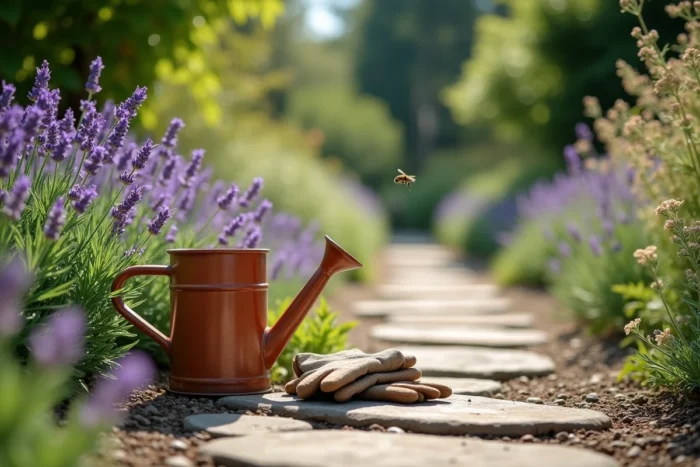
Limiting paved or concrete surfaces promotes the infiltration of water into the soil rather than its runoff into the sewer system. A path made of stepping stones, non-compacted gravel, or perforated grass allows water to reach the groundwater instead of overloading the pipes during storms.
A natural and environmentally friendly garden does not require more work, but a different kind of work. Turning off a spotlight, leaving a pile of leaves in place, or making a hole in a fence: these modest actions, repeated across thousands of plots, reconstruct an ecological network that concrete and pesticides have fragmented for decades.