A wedding letter that works relies on a precise mechanism: a singular memory, a detail observed in the person to whom you are writing, followed by a wish directed toward the future. Three stages, no more. The difficulty never lies in the literary style, but in the ability to select the right memory from years of shared life.
Narrative structure of a wedding letter: the skeleton that carries the emotion
A memorable wedding letter follows an architecture in three blocks. The first anchors the reader in a lived moment: a concrete scene, an exchange, a gesture. The second expresses what this moment has revealed about the bond between the author and the bride. The third projects this bond into the upcoming marriage.
We observe that letters that fail to move share a common flaw: they remain at the level of generic compliments. Writing “you are an amazing person” produces nothing. Writing “the evening you called me at 11 PM because you heard something was wrong in my voice” creates an image, and thus an emotion.
A specific memory is worth ten flattering adjectives. This is the basic rule. The memory must be specific enough that only two people in the world can recognize it. If any guest could sign the same phrase, it does not belong in the letter.
Seeking to make a wedding letter moving therefore relies less on vocabulary and more on sorting through memories. We recommend starting by listing five to ten shared moments, then keeping only one or two, those that still provoke a physical reaction when recalled.
Length and density: why half a page is enough for a wedding text
The most common mistake is to believe that a long letter will be more touching. The most converging feedback shows that a wedding letter ideally fits on half a page to a page. Beyond that, attention wanes, especially if the letter is read aloud during the ceremony.
A few very dense sentences may suffice. Emotional density is not measured by the number of words but by the ratio of concrete details to hollow formulations. A paragraph of three well-chosen sentences consistently surpasses an entire page of conventional vows.
Specifically, here are the elements to calibrate:
- The anchoring memory: two to four sentences that set the scene with enough sensory details (a place, a time, an object, a phrase heard) for the bride to find herself in the image.
- The transition to the bond: one to two sentences that explain what this moment has changed, confirmed, or revealed in the relationship.
- The final wish: one to three sentences oriented toward the couple’s future, not just the bride. Mentioning the partner gives the letter a more complete dimension.
This breakdown produces a text of a few hundred words. If the letter exceeds a handwritten page, it is generally a sign that it contains filler.
Mentioning the bride’s partner without shifting the focus of the letter
Including a sentence about the partner transforms the letter from a portrait into a couple’s wish. The current trend in wedding letter writing clearly goes in this direction: texts that completely ignore the person being married sound more like a funeral tribute than a celebration of union.
The most effective technique is to tie this mention to the main memory. For example, if the chosen memory is a trip between friends, the transition to the partner could be: “and when I saw you with [first name] for the first time after that trip, I understood that you had found someone who gave you that same freedom.”
Two pitfalls to avoid. The first: turning the mention into a portrait of the partner, which shifts the focus of the letter. The second: writing a conventional phrase like “I am sure he/she will make you happy,” which adds no information and sounds like a default wish. The mention should be brief, tied to a personal observation, and placed in the last third of the text.
Preparation for reading aloud: the work that no one does
Writing the letter is only half the work. Reading it in front of an audience without losing the thread or your voice requires technical preparation that most inspirational guides overlook.
Printing the text in large enough characters to be read at arm’s length is the first precaution. Reading on a phone or on a folded piece of paper guarantees hesitations, loss of lines, and a voice that falls to the ground.
- Marking breaths directly on the printed text, with a visible sign (a slash, a colored dot). The emotionally charged passages are those where the throat tightens: a pause should be placed before, not after.
- Reading aloud two or three times at most. Beyond that, the text loses its freshness and the reading becomes mechanical, which kills spontaneity on the big day.
- Preparing a backup version entrusted to a trusted person. If emotion prevents you from continuing, this person can take over without the bride losing a word of the letter.
The quality of the reading rests on a paradox: you need to repeat enough not to stumble over the words, but not so much that the emotion dulls. Two or three spaced readings over several days find this balance.
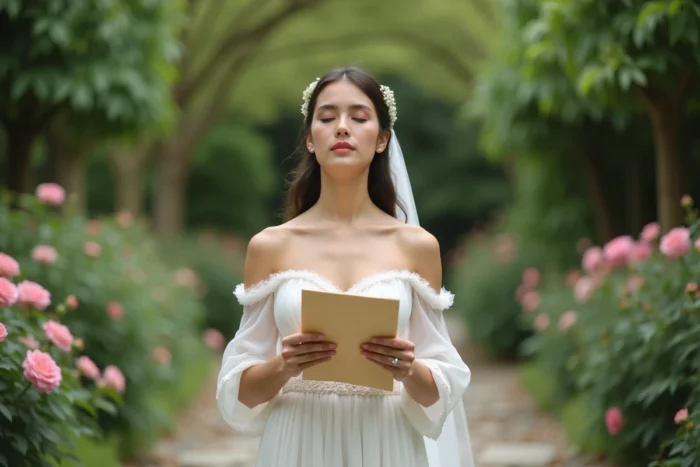
The true test of a successful wedding letter is not the reaction of the audience, but that of the bride six months later when she rereads the text alone. If the chosen memory instantly brings her back to the scene described, the letter has fulfilled its role. Everything else, the style, the length, the vocabulary, is just embellishment.