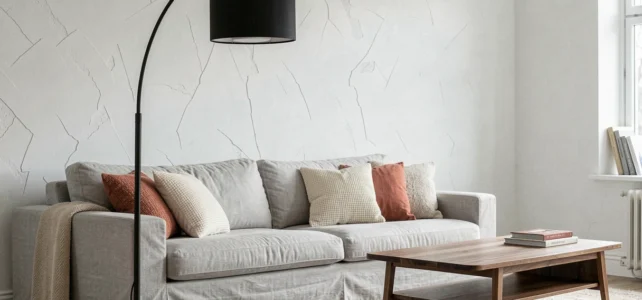
The choice of a black floor lamp for a contemporary interior is not just a matter of taste. The finish, the associated color temperature, and the geometry of the diffuser influence the overall perception of a room, sometimes even more than the furniture itself. Understanding these technical parameters helps avoid the most common casting mistakes.
Matte black or glossy black finish: impact on light reflection
A floor lamp in matte black absorbs incoming light instead of reflecting it. We find that this property makes it a relevant choice when it serves as a visual anchor in a living room where walls, textiles, and artworks are very colorful. Matte black provides a clear anchor to any color palette and allows surrounding materials to express themselves better.
Glossy black, on the other hand, creates distracting reflections in spaces with large windows or lacquered surfaces. This phenomenon is particularly bothersome in the evening when the light source from the floor lamp reflects on its own base. We recommend the glossy finish only in rooms with light walls and matte flooring, where the contrast remains controlled.
If you are looking for a modern black floor lamp from Deco Asaiss, always check the type of finish offered: the difference between matte and glossy can radically transform the ambiance of a room.
Black floor lamp and NF EN 12464-1 standard: illuminating beyond the work surface
The 2021 version of the NF EN 12464-1 standard has changed the game for indoor lighting. It requires attention to the lighting of walls and ceilings, not just the work surface. A black floor lamp directed only downward no longer meets this requirement, even in a residential setting where the standard serves as a comfort reference.
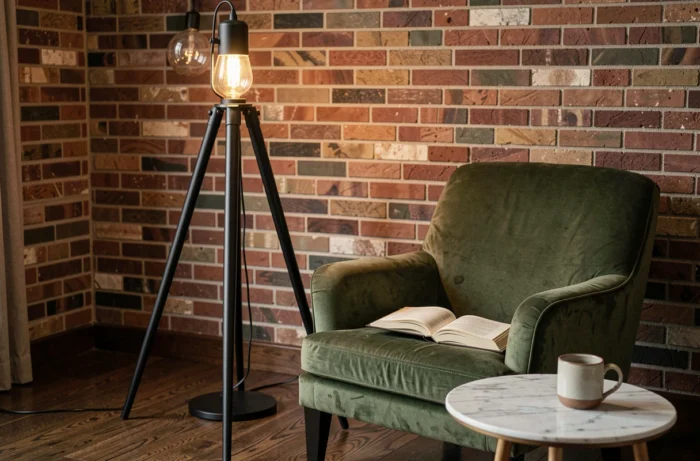
Specifically, a model with indirect light (pointing towards the ceiling) or mixed (direct/indirect) distributes light better throughout the room. The black metal of the upper reflector reflects less light than a white reflector, which requires choosing a more powerful source or compensating with an additional light fixture.
- A floor lamp with only downward light focuses the light on a restricted area and leaves the walls in shadow, creating an uncomfortable “cave” effect.
- An indirect light model projects light onto the ceiling, which redistributes it. The ceiling must be light for this principle to work properly.
- A mixed floor lamp combines both light flows and offers the best compromise for a living room or office, provided that the distribution is adjustable.
Before purchasing, check that the manufacturer indicates the percentage of direct and indirect light. A ratio of 60% indirect / 40% direct is suitable for most living rooms.
Pleated and wavy shapes: the trend that softens black
Strictly cylindrical or conical black floor lamps have dominated the market in recent years. Since 2024, pleated and wavy shapes, sometimes referred to as “ruffled,” have been multiplying in collections. These softer silhouettes break the sometimes austere graphic character of a black light fixture.
A pleated black lampshade diffuses light unevenly, creating micro-shadows on the folds of the fabric. The effect is more organic than a smooth diffuser. This type of floor lamp works particularly well in a Scandinavian or Japandi interior, where natural textures (linen, light wood, stone) call for less mechanical lighting.
We find that these soft shapes are also more forgiving of placement errors. A strict geometric floor lamp requires precise positioning to avoid looking out of place. A wavy model integrates more flexibly into a corner, next to a sofa, or near a bookshelf.
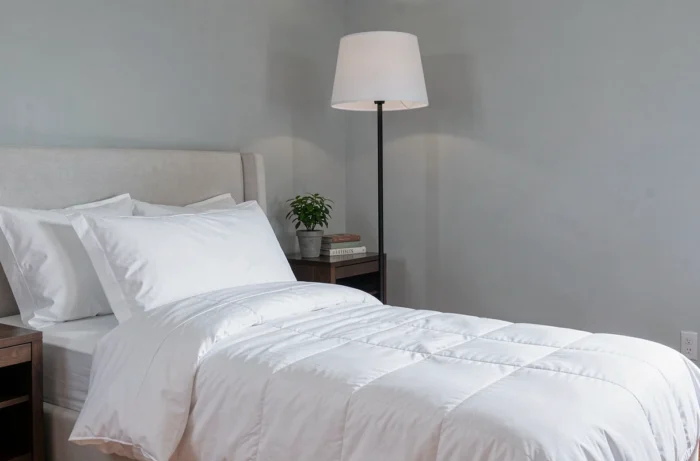
Combining a black floor lamp with other materials in the room
Black metal naturally pairs with light wood, but this combination has become somewhat automatic. To avoid a catalog effect, we recommend working with contrasting textures rather than just contrasting colors.
- Matte black metal + veined marble: the floor lamp visually anchors the room while the veins of the marble bring movement. This combination works well in a living room or entryway.
- Black metal + brushed brass: brass warms the black without competing with it. Limit brass to small accessories (handles, frames, candlesticks) to avoid overload.
- Black metal + boucle fabric (bouclette, teddy): the contrast between the rigidity of the floor lamp and the softness of the fabric creates an interesting visual tension, typical of current design interiors.
- Black metal + polished concrete: reserved for large spaces. In a room smaller than fifteen square meters, this combination can appear cold and industrial.
The classic trap is to multiply black elements in the room. A black floor lamp loses all its impact if it is next to a black coffee table, a black TV unit, and black shelves. Two to three black elements maximum per room are enough to structure the space without weighing it down.
Height and positioning: common technical mistakes
A large black floor lamp placed in a corner creates a powerful focal point. Placed in the middle of a wall, it competes with paintings or shelves. The simple rule: the floor lamp occupies a corner or flanks a piece of furniture (sofa, reading chair), never a narrow blank wall.
The height of the fixture in relation to the nearest seating determines the comfort of the lighting. If the bottom of the lampshade is at eye level for a seated person, glare is guaranteed. We recommend that the bottom of the diffuser be at least fifteen centimeters above the eye line when seated.
The base of the floor lamp, often overlooked, occupies a disk on the floor that can obstruct movement. Models with a fine base (stem and internal counterweight) are preferable in passage areas. Wide cast iron bases are better suited for protected corners where no one is likely to trip.
The black floor lamp remains one of the few decorative elements that combines lighting function and visual structuring of a space. When well chosen, it anchors a room. When poorly placed or mismatched, it destabilizes it. The finish, light flow, and positioning are as important as the design of the model.