A memorable party relies on a combination of concrete choices: the venue, the pace of the evening, the interactions between guests, and the management of practical constraints. Organizing an original party, whether it’s a birthday, a themed evening, or a gathering with friends, requires less of an extravagant budget than well-targeted decisions on a few high-impact levers.
Silent party and sound constraints: a game-changing format
Most party planning guides start with decoration or venue selection. Before that, a technical constraint dictates everything else: noise. Local noise regulations, condominiums, and atypical venues in city centers often limit amplified music.
The silent party (or silent disco) format directly addresses this issue. Each guest wears a wireless headset and chooses from several music channels. This setup allows for a dance party in an apartment, a shared garden, or a rooftop without generating noise disturbances for the neighbors.
Beyond the constraint, the silent party creates a surprise effect that leaves a mark on guests. Seeing people dance in silence, being able to switch from one music style to another, taking off their headsets to chat, then diving back into the music: the experience is both playful and social. To find suitable equipment for this type of party and other original formats, a useful resource is https://www.trouble-fete.fr/, which offers equipment and ideas for festive events.
Party theme and coherence: how to avoid the catalog effect
Choosing a theme for a party is a recurring piece of advice, but the difference between a successful themed evening and a disjointed result lies in the coherence between three elements: dress code, decoration, and activities.
A theme that is too broad (“80s”, “tropical”) allows each guest to interpret it in their own way, which dilutes the collective effect. A precise theme works better because it guides the choices.
- A unique color theme (all in white, all in pink) unifies the decoration and outfits without requiring elaborate costumes
- A narrative theme (“murder mystery”, “stranded on an island”) structures the activities and provides a thread throughout the entire evening
- A sensory theme (“candlelit evening”, “barefoot party in the grass”) influences the atmosphere without requiring a high decoration budget
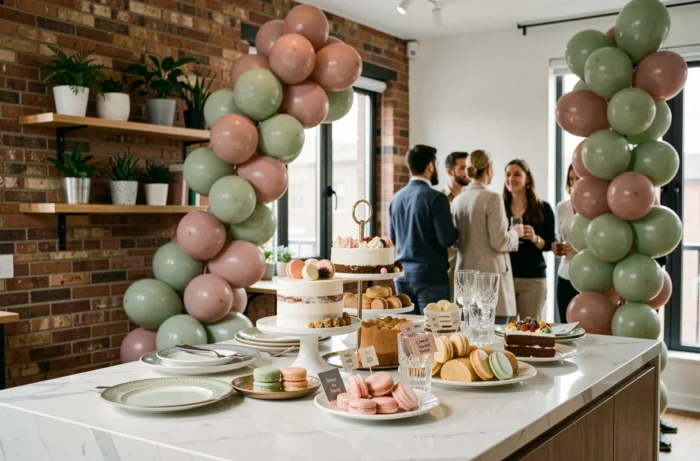
The classic pitfall: multiplying decorative elements (balloons, garlands, matching tablecloths) that have no connection to the chosen theme. Three well-aligned decorative elements are worth more than ten disparate accessories.
Activities and games for adults: structuring the rhythm of the party
A party without downtime relies on a balance between collective moments and free moments. Planning activities doesn’t mean turning the evening into a timed program, but having relays when the energy dips.
Games work particularly well when they mix guests who don’t know each other. A musical quiz in teams, a blind test, or karaoke create spontaneous alliances. For a birthday, a “true or false” game about the guest of honor leads to laughter and shared anecdotes.
The concept of zones in space
Rather than concentrating all the entertainment in one spot, dividing the space into distinct zones gives guests the freedom to move around. A quiet area with comfortable seating, a dancing corner, a board game space, or a DIY cocktail bar are enough to create a natural flow throughout the evening.
This approach also works in a small space. A simple change in lighting between two rooms (warm light in the living room, colored light in the kitchen) is enough to differentiate the atmospheres.
Party budget: deciding between the truly important items
The budget is often the first barrier to organizing an event. The temptation is to cut back a little on each item. A more effective approach is to focus the budget on one or two high-impact elements and make radical savings on the rest.
The food and drink category usually takes up the largest share. A participatory buffet (each guest brings a dish) significantly reduces this cost while diversifying the menu. A homemade birthday cake, even if imperfect, creates more memories than a purchased tiered cake.
On the other hand, lighting and sound deserve targeted investment. A dimmable string light and a quality speaker can transform any living room. The lighting atmosphere is the most underestimated lever for creating a festive atmosphere without excessive decoration.
Accessibility and guest well-being: an often-overlooked angle
Recent practices in event organization incorporate concrete well-being measures, not just a welcoming speech. For a private party, this translates into simple gestures that change the guests’ experience.
- Providing accessible self-service water, not just at the bar, reduces fatigue and dehydration during dance parties
- Identifying a quiet area where guests can isolate themselves for a few minutes helps those sensitive to sensory overload
- Communicating the schedule in advance (approximate timing for the cake, games, loud music) allows guests to manage their energy
These considerations cost nothing and are part of what distinguishes a well-thought-out party from a simply noisy evening.
The detail that most organizers overlook is at the end: planning a farewell as thoughtful as the welcome. A little note, a keepsake to take home (polaroid photo, candy bag, shared playlist the next day) extends the party well beyond the last song.