The nursery rhyme “Hands up, rabbit skin” belongs to those formulas that almost everyone can recite without ever knowing where they come from. Behind its absurd lyrics and its chanted rhythm, this song mixes oral tradition, popular slang, and gestural play. Understanding what connects these elements allows us to gauge why this nursery rhyme has endured through the decades without losing its charm.
The word rabbit in French slang: a lexical field richer than it seems
Before looking at the nursery rhyme itself, we must focus on the word that constitutes its pivot. In popular French, the word rabbit carries several layers of meaning. It evokes liveliness, fertility, but also flight and cowardice.
Studies on the expression “to stand someone up” remind us that, in Parisian slang of the mid-19th century, the word “rabbit” referred to the money owed to a prostitute. “To stand someone up” meant not paying what one owed, and by extension, not showing up for an appointment.
This ambivalence (an agile animal that evades, a symbol of cowardice) allows for a more nuanced reading of “rabbit skin”: the image of an easy victim, a being that one “strips.” In a nursery rhyme that mimics a hold-up with “hands up,” the choice of rabbit takes on a playful yet biting dimension.
Articles discussing the origin of the song hands up rabbit skin generally do not connect these slang layers with each other.
| Expression with “rabbit” | Slang meaning | Possible link with the nursery rhyme |
|---|---|---|
| To stand someone up | Not to pay, then not to show up | Concept of debt and flight |
| Hot rabbit | Lively, impulsive person | Gestural energy of the game |
| Rabbit skin | Worthless object, skin | Symbolic victim of the mimed hold-up |
| Run like a rabbit | To flee, to evade | Dynamic of play among children |

Lyrics of the nursery rhyme hands up rabbit skin: variants and oral fluidity
The most widespread version follows a simple pattern: “Hands up, rabbit skin, feet up, game meat, the teacher in a swimsuit.” Other versions circulate, sometimes truncated, sometimes extended depending on the region or time period.
No version has been fixed by an identified author. The nursery rhyme belongs to pure oral tradition. It has no claimed composer, no known date of first publication, nor original publisher. This fluidity explains the plurality of texts.
Several points distinguish the variants from one another:
- The mention of “the teacher in a swimsuit” appears in the majority of school versions, but some replace it with other characters or omit it
- The segment “feet up, game meat” functions as a prolongation rhyme, sometimes absent in the shorter versions
- Some regional variants add verses about other animals or other body parts, transforming the nursery rhyme into an accumulation game
This type of fluidity is common in nursery rhymes transmitted orally. The melody remains stable, but the text adapts to each context of transmission, making any attempt to reconstruct an “original text” illusory.
Hold-up nursery rhyme: the gestural and theatrical dimension of play
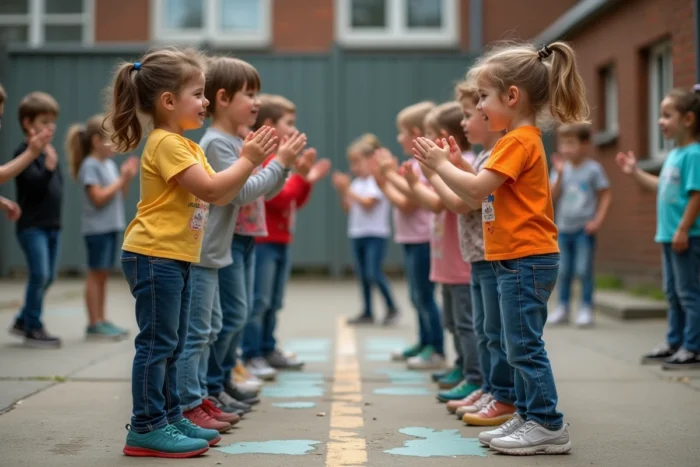
What distinguishes “Hands up, rabbit skin” from dozens of other nursery rhymes is its theatrical dimension. The expression “hands up” reproduces the command of a robber. Children raise their arms, mime the scene, and then follow the gestures as the lyrics progress.
The nursery rhyme functions as a micro-scenario of a hold-up transposed into an absurd register. The “rabbit skin” immediately diffuses the tension created by “hands up.” This shift between threat and nonsense produces the comedic spring.
A spring shared with other gestural nursery rhymes
This mechanism (tension then absurdity) is found in other sung games from the French children’s repertoire. The uniqueness of “Hands up” lies in the clarity of the staging: one simple gesture is enough to enter the game. There is no need to know all the lyrics; it is enough to raise the arms.
This gestural accessibility partly explains the longevity of the nursery rhyme. In schoolyards, leisure centers, and kindergarten classes, a game that starts with a universal gesture spreads faster than a game requiring the learning of a complete choreography.

Musical reprise and circulation of the nursery rhyme outside the school environment
Beyond the children’s framework, the phrase “Hands up, rabbit skin” has been reused in several adult contexts. Artists have incorporated this phrase into songs with a festive or humorous tone, playing on the immediate recognition of the formula by the audience.
The nursery rhyme has transitioned from a school game to a shared cultural reference. It can be found cited in films, sketches, and television shows. Its evocative power lies in its brevity: three words are enough (“hands up”) for the listener to mentally complete the rest.
This ability to function as an instant memory signal distinguishes “Hands up, rabbit skin” from longer or more complex nursery rhymes. The formula acts as a cultural trigger, recognizable regardless of the age or region of origin of the person hearing it.
The journey of this nursery rhyme illustrates a recurring mechanism in French oral culture: the shortest and most absurd formulas are the ones that survive the best. Rhyme, gesture, and nonsense form a sufficient trio to traverse generations without needing an author, a publisher, or a written support.