Writing a letter to your son is not just about stringing together affectionate phrases. The choice of tone, timing, and medium influences the impact of the message. Here, we offer ten targeted templates for different occasions, each based on a distinct writing mechanism: family narrative, projection, admission of vulnerability, or transmission of values.
1. Birth Letter: Anchoring the Family Narrative from Day One
The work of Marshall Duke and Robyn Fivush, reported by Emory News in April 2020, links knowledge of coherent family stories to better self-esteem in children. This finding forms the basis of the first model: telling a family trial or origin story rather than multiplying compliments.
We recommend writing this letter in the days following the birth, by hand if possible. Describe the specific context of your son’s arrival, name the people present, and mention a sensory detail (a sound, a light, a smell). This type of narrative, read years later, serves as an identity anchor.
Example opener: “You were born on a Tuesday, under a light rain. Your grandmother was waiting in the hallway with a book she never opened.” The strength of this letter lies in its factual precision, not in its superlatives.
2. Birthday Letter for a Child: Reflecting on the Past Year, Not the Future
Most birthday templates project wishes into the future. We recommend the opposite. Dedicate the letter to a specific event from the past year where you observed your son growing. Touching letters to your son gain sincerity when they are based on a shared memory.
Structure the text in three parts: the memory (two sentences), what it taught you about your son (one sentence), and how you feel thinking back on it (one sentence). This framework prevents drifting into empty phrases.
3. Letter for a Teen in Crisis: Naming Your Own Vulnerability
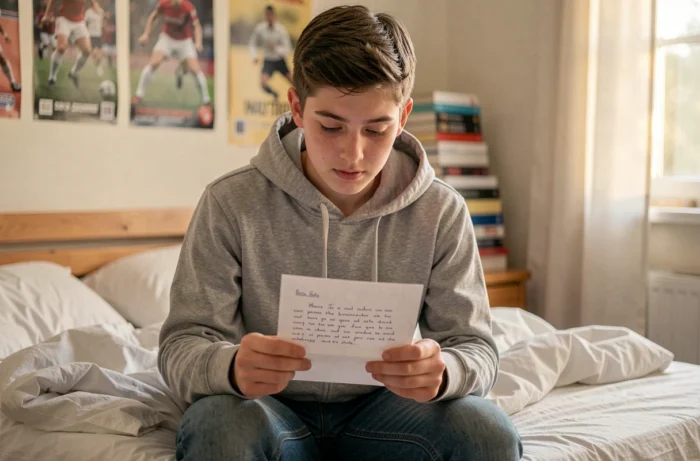
Writing to a teenager going through a tough time requires resisting two reflexes: moralizing and reassuring at all costs. The most effective lever remains the admission of a personal doubt experienced at the same age.
Example: “At fifteen, I was afraid of not measuring up. I didn’t talk to anyone about it. I’m telling you today because that fear didn’t stop me from moving forward, but silence did slow me down.” This type of phrase creates a bond without pressure.
Avoid phrases like “I’ll always be there for you,” which sound like a slogan. Prefer a concrete fact: “If you need to talk at three in the morning, my phone will be on.”
4. Congratulations Letter for a Diploma: Valuing Effort, Not Result
A congratulations letter focused solely on success misses the point. We recommend describing a specific moment when you saw your son working, doubting, or trying again. Congratulating the process rather than the diploma reinforces intrinsic motivation.
Possible opener: “I remember that Sunday evening when you reread your notes three times with a sigh. You didn’t earn that diploma on the day of the ceremony. You earned it that night.”
5. Letter Before Departure: Transmitting an Object or Ritual, Not Advice
When a son leaves home for studies, a job, or a trip, there is a strong temptation to create a list of recommendations. This format rarely produces emotion. Instead, associate the letter with a physical object: a copied family recipe, an annotated photo, a book with a highlighted passage.
The text itself can be short. Three sentences are enough if the object speaks. The goal is to create a material transmission ritual that your son can keep.
6. New Year Letter: Formulating a Unique and Specific Wish
Generic wishes (“I wish you happiness, health, success”) have no memorable value. Choose a single wish, formulated concretely. For example: “This year, I wish you a laugh that lasts so long it makes your sides hurt.”
A unique and vivid wish sticks in memory. Ten vague wishes are forgotten before the end of January.
7. Apology Letter: Describing the Wrong Without Justifying It
Apologizing in writing requires a rigor that oral communication does not always allow. The rule: precisely describe what you did, without explaining why. Any justification (“I was tired,” “I was going through a tough time”) dilutes the apology.
Recommended structure:
- Name the criticized fact in a factual sentence, without minimizing
- Acknowledge the impact on your son in his own words, not yours
- Propose a concrete gesture of repair, not an abstract promise
8. Letter for a Son Who Became a Father: Writing as a Peer
This model marks a change in tone. You are no longer writing from parent to child, but from parent to parent. Share a memory of your own beginnings as a father or mother, with its awkwardness.
Example: “The first night, I checked six times to see if you were breathing. I didn’t yet know that worry would never go away. It just changes form.” This peer tone, without condescension, gives the letter a significance that traditional congratulations do not reach.
9. Handwritten Letter of Ordinary Gratitude: Without a Particular Occasion
A study published in January 2024 in Frontiers in Psychology by researchers from NTNU observed that written communication engages more brain connections associated with memory than typing on a keyboard. This finding justifies a model of letter without a calendar pretext, written by hand.
Write to your son to tell him what you haven’t had the chance to verbalize recently. No grand feelings: a detail, a habit, a character trait you appreciate. The rarity of this type of letter gives it power.
10. Emotional Testament Letter: What You Want Him to Know No Matter What
This last model is the most demanding. It involves writing a letter intended to be read in your absence. The trap would be to try to say everything. Limit yourself to three elements:
- A shared memory that summarizes your relationship
- A value you hope to have transmitted to him, phrased without injunction
- A closing sentence that gives him permission to move forward
This type of letter is kept in a sealed envelope, dated, entrusted to a close person, or stored with personal documents. Its value lies not in its length but in its very existence.
Each of these models is based on a common principle: the precision of detail outweighs the accumulation of feelings. A well-chosen three-sentence letter will mark your son more than an entire page of affectionate phrases. The handwritten, dated, and signed medium adds a dimension that digital cannot replace.